
Welcome to building.co.uk. This site uses cookies. Read our policy.
All the latest updates on building safety reform

2024 events calendar 
Building Awards
2014-02-28T00:00:00+00:00
This module explains the key changes to the energy efficiency provisions of the Building Regulations, which come into force in April. It is sponsored by Celotex
The free continuing professional development distance learning programme from Building is open to anyone who wants to develop and improve their professional knowledge. These modules can contribute towards annual CPD activity and help you to maintain membership of professional institutions and bodies.
To take this module, read the technical article above and click through to the multiple-choice questionnaire.
Once taken you will receive your results and if you successfully pass you will be automatically issued with a certificate to print for your records. This module will contribute one hour towards your CPD obligations.
DEADLINE: 11 APRIL 2014.
The 2013 revision to Part L of the Building Regulations is a key milestone towards the government’s target for all new homes to be zero-carbon by 2016, and new non-domestic buildings by 2019. Following a long consultation period, new carbon emission targets were published in November 2013. These set a 6% improvement on the 2010 Part L targets for housing on aggregate – which means there may be flexibility across different types of homes – and a 9% improvement on aggregate for non-housing. As the industry gears up for the introduction of the revised Part L on 6 April 2014, this CPD sets out to explain the method behind it, and show how it can be implemented.
The key factors that influence a building’s fabric energy efficiency are:
The TFEE is calculated by determining the fabric energy efficiency from a notional dwelling of the same size and shape as the actual dwelling. This value is then increased by 15% to give the TFEE.
In the elemental recipe column, the DFEE represents the energy use of the notional dwelling; the TFEE is this figure multiplied by 1.15. The second column shows that by introducing higher performance glazing into the recipe, the walls and floor can be allowed slightly higher U-values without adversely affecting the DER or DFEE.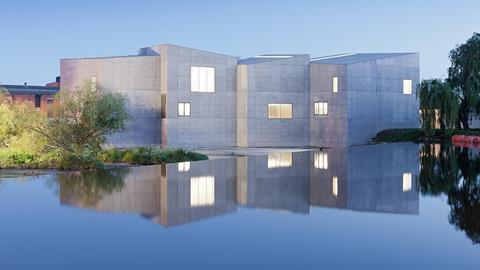
Celotex PIR insulation was used to line the concrete walls and floors of the Hepworth Wakefield to help the gallery achieve very low U-values
Part L 2013 makes no changes to the U-values required when making home improvements. The maximum values are shown in the table below:
Commercial and other non-domestic buildings will not be expected to meet the requirements for FEES, and therefore the SBEM approach is not noticeably different from 2010. The main change is the 9% aggregate increase on the TER, and the fact that greater variation is included between building types, as shown below:
Another change is that there is a wider set of notional buildings used to determine CO2 targets. The three building types are:
Limiting U-values are unchanged from 2010, regardless of the notional building type. These are: 0.26W/m2K for walls, 0.22W/m2K for floors, 0.18W/m2K for roofs and 1.6W/m2K for windows (although this does not apply to top-lit buildings).
However, there is variation in the notional buildings’ air permeability, which have been subdivided by size. This is because the larger the building, the easier it is to achieve airtightness. The new values are as follows:
A summary of the Part L2A notional buildings is published in Section 5: Model Designs of the Approved Document. If the actual building is constructed to the notional specifications it will meet the CO2 targets and the limiting fabric and building services parameters. However, developers are free to vary the specification, provided the same overall level of CO2 emissions is achieved or bettered.
The free continuing professional development distance learning programme from Building is open to anyone who wants to develop and improve their professional knowledge. These modules can contribute towards annual CPD activity and help you to maintain membership of professional institutions and bodies.
To take this module, read the technical article above and click through to the multiple-choice questionnaire.
Once taken you will receive your results and if you successfully pass you will be automatically issued with a certificate to print for your records. This module will contribute one hour towards your CPD obligations.
DEADLINE: 11 APRIL 2014.
Information you supply to UBM Information Ltd may be used for publication and also to provide you with information about our products or services in the form of direct marketing by email, telephone, fax or post. Information may also be made available to third parties. UBM Information Ltd may send updates about Building CPD and other relevant UBM products and services. By providing your email address you consent to being contacted by email by UBM Information Ltd or other third parties. If at any time you no longer wish to receive anything from UBM Information Ltd or to have your data made available to third parties, contact the Data Protection Coordinator, UBM Information Ltd, FREEPOST LON 15637, Tonbridge, TN9 1BR, Freephone 0800 279 0357 or email ubmidpa@ubm.com. View our full privacy policy at www.building.co.uk/cpd
2014-03-13T08:30:00Z
The latest minor upgrade to Part L of the Building Regulations is symptomatic of a wider malaise
2022-11-18T05:00:00Z
This CPD sponsored by ROCKWOOL examines the issues around acoustic performance in schools, sets out the relevant regulations and standards, and explains some of the solutions available. Deadline for completion Friday 30 December 2022.
2022-01-07T12:17:00Z
This Radiana sponsored CPD will look at how radiant cooling works and why it can be an efficient method for reducing overheat in a development without adding pressure to the climate. DEADLINE TO COMPLETE: 14th January 2022
This CPD, sponsored by VELUX Commercial, explains how the maximising of daylight through bespoke structural glazing can improve wellbeing and productivity of a building’s occupants as well as cutting energy costs, and sets out the specification considerations
This Kingspan sponsored CPD takes a close-up look at the requirements of Passivhaus and how offsite approaches are making it increasingly viable and cost effective – DEADLINE TO COMPLETE: 13 November 2020
This TECHNAL sponsored CPD explains what designers need to consider when specifying architectural glazing packages that involve increasingly demanding acoustic requirements – DEADLINE TO COMPLETE: 31 August 2020
Site powered by Webvision Cloud